The Art of Felting
Between ancestral handcraft
and contemporary creativity.
A thousand-year-old history
Felting is an ancestral artisanal process, much older than spinning and weaving techniques. It is often thought to have originated by accident in the steppes of Central Asia, among the nomadic peoples who used it and still use it for the manufacture of yurts, carpets and clothing. A fleece acting as a horse saddle, the combined effect of humidity and friction that aggregates the wool fibers: the birth of felt! No doubt, but not only.
Its origin goes back much further, probably as early as the Neolithic, a period when wild sheep were gradually domesticated by man, who settled down and learned to cultivate the land.
Wool felt is the very first "textile", a non-woven fabric. It is easy to imagine the importance of this discovery for humans at the time: protection, warmth, insulating power. A real treasure!
Today, after crossing eras and continents, the art of felt continues to acquire power and creative richness.
Let’s talk felting, stamping and the virtues of wool
Felting
A little clarification: artisanal wool felt has nothing to do with industrial felt, boiled "wool" or other artificial fiber.
Natural wool, water, soap, some ideas and a lot of elbow grease: that's the recipe!
How can such a modest and sober process give birth to such creations, to this infinitely rich material of possibilities, not to mention the happiness of wearing a felted wool garment?
There is magic in this art!
All these creations are the result of long manual work, where, thanks to the combined effect of friction and soapy water, the microscopic scales, located all around the wool fibers, open, cling to each other, amalgamating the other fibers present around.
Fulling
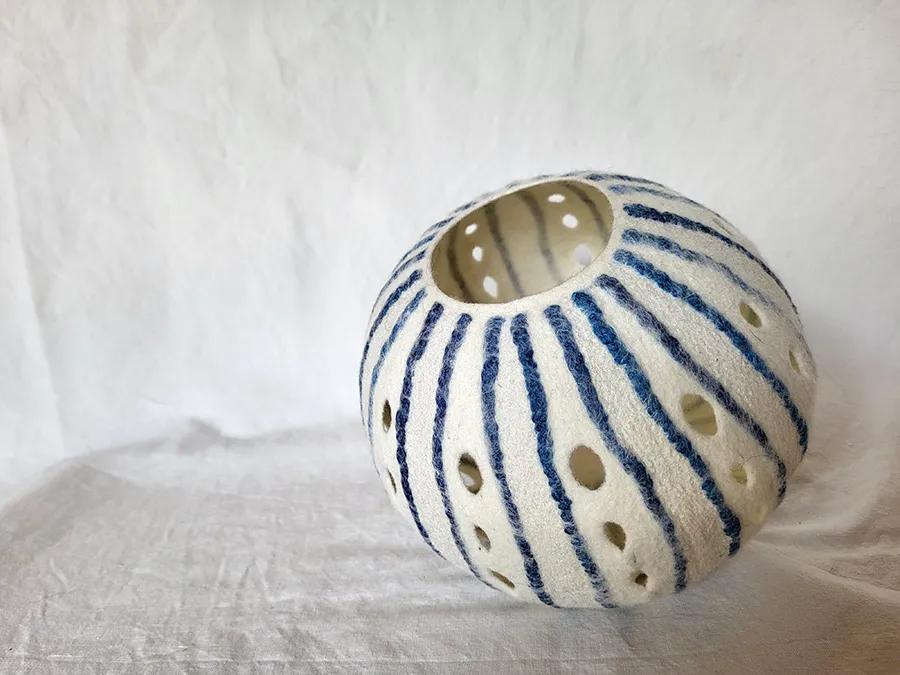
Fulling, fulling! After the long work of rolling, kneading, fulling…the famous shrinkage will come, giving shape to this astonishing dense and solid matter. With countless qualities and beneficial properties, with multiple applications: thermal insulating while being breathable. It can be rigid or flexible and elastic as required. Hydrophobic, it repels water and dirt. Fire retardant, sound insulation...
It's quite simple: wool has all the virtues! It is high time to give it back the place it deserves and to encourage its promotion in all its forms.

The materials I use happily
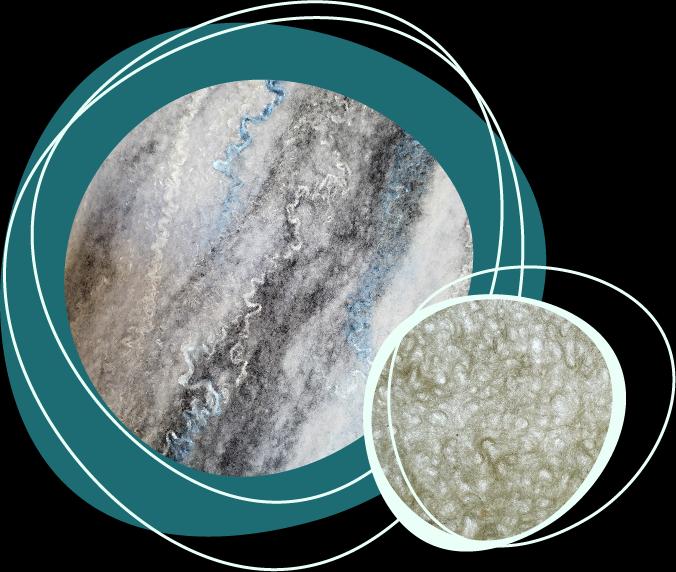
The heart of my work is based on wool, this natural, renewable and versatile fiber.
Depending on the project, I like to integrate other materials to create contrasts or particular textural effects.
Merino wool
My clothes and any creation in contact with the skin are made with merino wool chosen for its extreme softness. I favour French or European breeding, in particular Merilainos wool, from French breeders committed to promoting the wool of the Merino sheep of Arles. I really like the wool of very small local herds, especially the East breed with Merino wool.
Country wools
My accessories and decorative objects, on the other hand, love the wonderful country wools for the character they bring them. Very endearing sheep faces with inspiring names: Noire du Velay, Bizet, Thones and Marthod, Ouessant, Gotland, Wensleydale... A few breeds among many others and they are all exciting to felt.
Silk and plant fibers
I incorporate silk and plant fibers such as linen, nettle, hemp for their unique visual and tactile effects. These natural materials blend nicely with wool, adding texture or transparency.
Recycled fabrics and forgotten yarns
It's important for me to give a second life to materials that have a history. I embed fabric scraps or bits of thread in most of my designs, striving to create pieces that are both durable and aesthetically pleasing.
An Art in Evolution
The discovery of wool felt was love at first sight. It's my medium.
I try to explore it from various angles: textures, transparencies, shapes, colours but also the variety of wools and fibres used. The art of felting seems to me to be a limitless playground and the creative freedom it gives me is extremely beneficial.
Through this art, I seek to offer sustainable pieces, respectful of the environment and animal welfare. This need now pushes me to work with undyed wools, sourced as locally as possible. I have always been attracted to natural dyes, and I am training with master dyers recognized in this specialized field. In the very near future, my goal is to offer only creations that are naturally dyed by me.